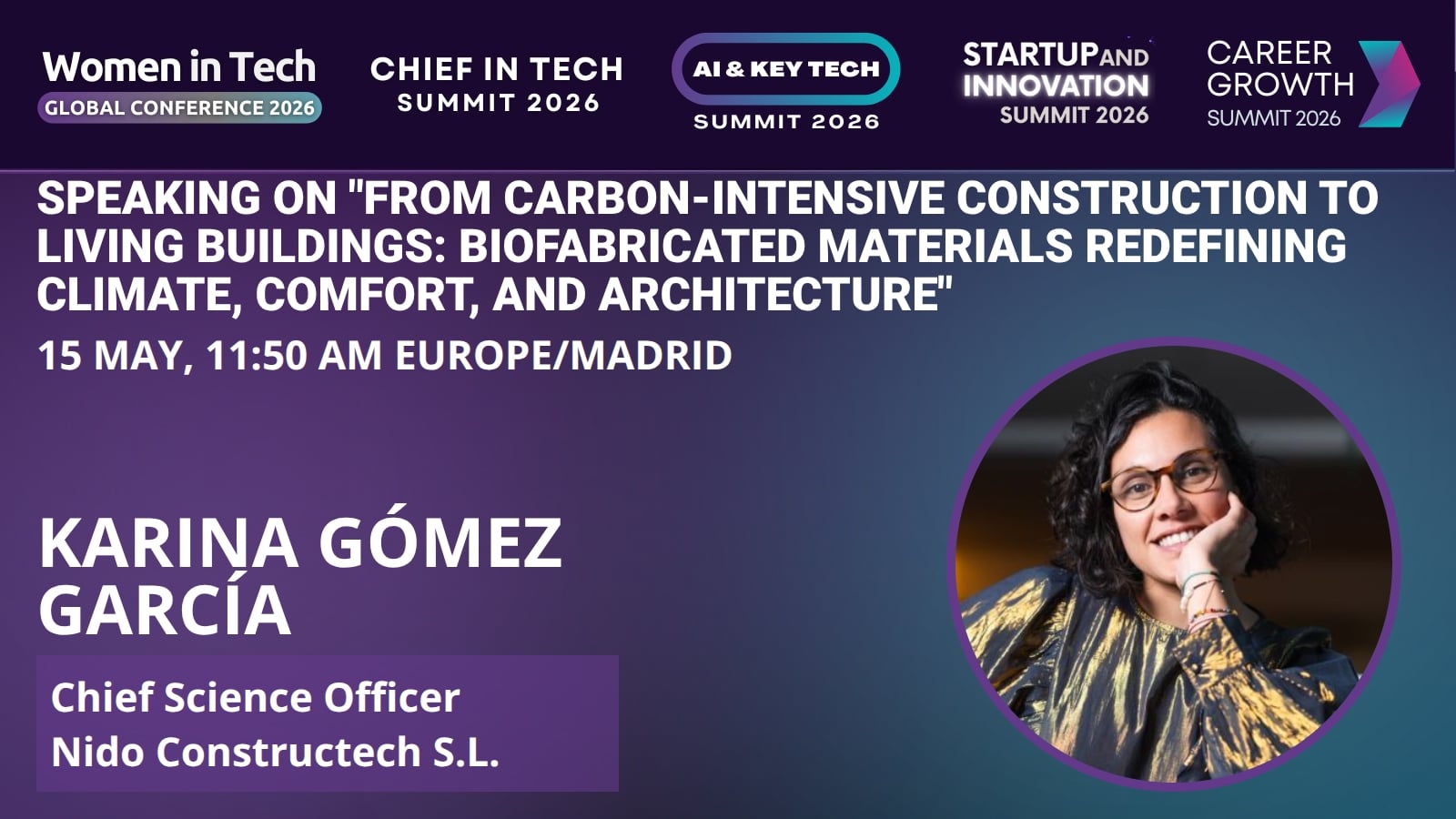

Karina
Gómez García
Chief Science Officer at Nido Constructech S.L.

"From Carbon-Intensive Construction to Living Buildings: Biofabricated Materials Redefining Climate, Comfort, and Architecture"
"From Carbon-Intensive Construction to Living Buildings: Biofabricated Materials Redefining Climate, Comfort, and Architecture"
Fri May 15 - 5:50 AM EDT/New York (See in local time)
Add to Calendar
05/15/2026 5:50 AM
05/15/2026 06:00 AM
America/New_York
#WTGC2026
"From Carbon-Intensive Construction to Living Buildings: Biofabricated Materials Redefining Climate, Comfort, and Architecture"
#WTGC2026
"From Carbon-Intensive Construction to Living Buildings: Biofabricated Materials Redefining Climate, Comfort, and Architecture"
https://www.womentech.net/ringcentral
https://www.womentech.net/ringcentral
"From Carbon-Intensive Construction to Living Buildings: Biofabricated Materials Redefining Climate, Comfort, and Architecture"
"From Carbon-Intensive Construction to Living Buildings: Biofabricated Materials Redefining Climate, Comfort, and Architecture"
Don’t miss out and join visionaries, innovators, and thought leaders from all over the world at the Women in Tech Global Conference.
Vote by Sharing
Unite 100 000 Women in Tech to Drive Change with Purpose and Impact.
Do you want to see this session? Help increase the sharing count and the session visibility. Sessions with +10 votes will be available to career ticket holders.
Please note that it might take some time until your share & vote is reflected.
Session: From Carbon-Intensive Construction to Living Buildings: Biofabricated Materials Redefining Climate, Comfort, and Architecture
The construction sector stands at the center of the global climate crisis, accounting for nearly 39% of global CO₂ emissions. While a significant share comes from building materials, the largest impact lies in how buildings consume energy: in Europe, heating and cooling represent around 70% of total building energy demand, generating hundreds of millions of tonnes of CO₂ every year in a system still heavily dependent on fossil fuels and high-carbon electricity. This dependency not only accelerates climate change, but also drives up costs, deepens energy poverty, and affects public health, while progressively degrading the architectural and urban quality of our cities.At the same time, Europe is rapidly moving toward the electrification of heating through heat pumps and aerothermal systems. Without passive solutions capable of buffering demand, this transition will place growing pressure on electrical grids, leading to consumption peaks, blackout risks, and costly infrastructure expansion. In parallel, the materials sector faces a critical paradox: mineral-based materials provide the thermal mass, acoustic performance, and fire resistance required by regulations, but at a high carbon cost; timber, while structurally efficient and low-carbon, lacks this mass, forcing the addition of mineral layers that undermine its environmental benefits. Today, Europe urgently needs materials that combine biogenicity and mass, yet 95% of bio-based materials on the market are lightweight insulators, unable to provide thermal inertia. This lack of sustainable mass has become one of the main barriers to the true decarbonisation of the built environment.
It is within this context that NIDO Constructech emerges, a women-led deep-tech startup working at the intersection of biotechnology, materials science, and nature-based solutions to redefine how we build and inhabit our cities. At NIDO, we develop biofabricated materials inspired by living systems, capable of addressing the energy, material, and climate challenges of the construction sector simultaneously. In this talk, I will present the Algae Panel, the first bio-based material capable of delivering true thermal mass, acoustic mass, and fire resistance without relying on cement, gypsum, or mineral products. Made from brown-algae alginate and structured water, the panel behaves as a genuine “living mass”: storing heat, dissipating sound, and enhancing fire safety, while remaining fully inert, circular, and industrially scalable. This innovation unlocks the large-scale adoption of timber construction and aligns fully with the European Blue Bioeconomy Strategy, Horizon Europe, and the New European Bauhaus.
The talk also introduces BAC Control, a new generation of Engineered Living Materials that transforms the building envelope into a self-regulated, zero-energy thermal system. Through the safe encapsulation of extremophile bacteria within sealed façade and roof panels, buildings can sense temperature changes and respond autonomously, releasing or absorbing heat without electricity or refrigerants. Architecture thus shifts from being a passive energy consumer to becoming an active, resilient organism, capable of reducing emissions, improving indoor health, and relieving pressure on energy grids.
Beyond technology, this talk is an invitation to reimagine the future of the built environment through a female, scientific, and systemic lens, demonstrating how women-led deep-tech innovation can transform the climate crisis into an opportunity to create fairer, more beautiful, regenerative, and human-centred cities, where buildings evolve from part of the problem into an essential part of the solution.
Key Takeaways
- How Nature-Based Solutions can be transformed into scalable technologies and business models, inspired by living systems and capable of delivering climate, economic, and social impact at the same time.
- How biofabricated materials can reduce both embodied and operational carbon, enabling buildings that store heat, regulate temperature, and reduce dependence on energy-intensive HVAC systems.
- The importance of building strategic alliances with early adopters and leveraging tools such as carbon credits and decarbonisation strategies to enable faster adoption and scaling of climate technologies.
- Why women-led leadership in deep tech is critical for systemic climate innovation, and how diversity drives more resilient, regenerative, and human-centred technological solutions.
Bio
Karina Gómez García is a strategic leader in climate innovation, working at the intersection of science, industry, and policy to connect Latin America and Europe through scalable, nature-based technologies. With a background in Biochemistry, a Master’s in Sustainable Business Strategy, and an MBA, she focuses on transforming natural intelligence into high-impact business models capable of decarbonising carbon-intensive industries.She is the Co-founder and Chief Scientific Officer of NIDO Constructech, a deep-tech startup developing regenerative biomaterials and bio-adaptive building systems that redefine how cities are built, heated, and cooled. Her work spans from bio-fabricated construction materials to off-grid microbial thermal systems, designed not only to reduce emissions but to fundamentally shift value creation in the built environment.
Karina is the inventor of three international patents and a member of the International Advisory Committee of the International EPD System, where she leads the evolution of Life Cycle Assessment (LCA) methodologies for biomaterials and Nature-Based Solutions in construction and energy. She actively builds strategic alliances across academia, industry, and public institutions—from Cambridge and Wageningen to EU-level consortia—accelerating investment, regulation, and market adoption of regenerative technologies.
Her leadership has been recognised internationally with awards including Startup of the Year 2024 (Rebuild–CEMEX), the Mondragón Deep-Tech Innovation Award, the EIC Accelerator Seal of Excellence (European Commission), and the Inspiratec Chile Award 2025. In 2025, she was highlighted by Smart City Expo World Congress Barcelona as a leading voice in biomaterials, participating in high-level dialogues alongside policymakers and industry leaders on impact measurement and implementation.
She is currently part of a European consortium awarded major EU funding to scale macroalgae-based biorefineries and regenerative biomaterials, and was selected by the Chilean government to join an official mission to Japan and Expo 2025 Osaka, contributing to the development of a new carbon methodology under the Japan-Chile JCM and Article 6 of the Paris Agreement.